
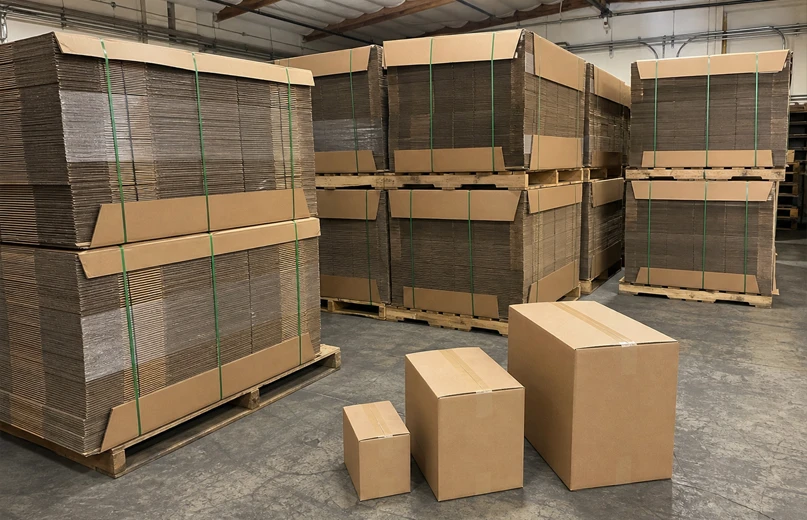
How to Choose the Right Corrugated Box Size and Strength for Shipping
Quick answer: Choose a corrugated shipping box by matching its inside dimensions to the product, allowing only enough room for cushioning, and selecting board strength for the packed weight, stacking conditions, handling, and shipping environment. The smallest box is not automatically the best box; it must still protect the contents throughout distribution.
How are corrugated box dimensions listed?
Corrugated boxes are normally described as length × width × depth. Length is the larger dimension of the box opening, width is the smaller dimension, and depth is measured from the opening to the bottom. When ordering a box for product fit, confirm whether the dimensions shown are inside or outside dimensions.
Inside dimensions help determine whether the product and cushioning will fit. Outside dimensions matter for pallet patterns, storage racks, conveyors, carrier limits, and the total space occupied during transportation.
What is an RSC box?
A Regular Slotted Container, commonly called an RSC box, is one of the most widely used corrugated shipping box styles. Its four top and bottom flaps meet in the center when closed. RSC boxes are practical for many general shipping, storage, and distribution applications because they ship flat and can be closed with packaging tape or another suitable method.
How much extra space should a shipping box have?
Allow enough clearance for the cushioning system without creating excessive empty space. Too little room can make the box difficult to close or leave the product insufficiently protected. Too much space can allow movement, increase void-fill use, and take up unnecessary storage and transportation capacity.
Before selecting a size, measure the product at its widest points and consider inserts, bags, dividers, corner protection, bubble cushioning, foam, or paper that will be packed with it. For multiple items, test the intended arrangement rather than adding dimensions independently.
ECT and box strength: what should buyers consider?
ECT means Edge Crush Test. It is used to evaluate the edgewise compression strength of corrugated board and is relevant when stacking strength matters. A higher ECT value does not by itself guarantee that a box is correct for every shipment. Box size, board construction, product weight, stacking pattern, humidity, pallet overhang, handling, and time under load can all affect performance.
When comparing box specifications, provide the supplier with the packed weight and describe how the boxes will be stacked, stored, palletized, and transported. Heavy, fragile, irregular, or high-value products may require testing or a custom packaging recommendation.
Corrugated box selection checklist
- Measure the product and identify required cushioning.
- Confirm whether listed dimensions are inside or outside dimensions.
- Calculate the total packed weight, not just product weight.
- Consider stacking height, pallet pattern, and possible pallet overhang.
- Review moisture, temperature, vibration, and handling conditions.
- Choose an appropriate closure method and packaging tape.
- Test the completed package when product risk or shipping conditions justify it.
Stock boxes or custom corrugated boxes?
Stock shipping boxes are a practical choice when standard dimensions provide a good fit and quantities vary. Custom boxes may be worthwhile when a specific size can reduce excess space, improve packing speed, protect an unusual product, support pallet efficiency, or add printed branding and handling information.
Frequently asked questions
Are box dimensions measured inside or outside?
Corrugated boxes are commonly specified by inside dimensions, but buyers should always confirm. Outside dimensions remain important for palletization, machinery, storage, and carrier requirements.
What does 32 ECT mean?
It is an edge crush rating for corrugated board. It should be evaluated together with the box design, packed weight, distribution environment, and stacking requirements rather than treated as a universal weight limit.
When should a business consider a custom box?
Consider custom corrugated packaging when stock sizes create excessive empty space, the product requires special protection, packing efficiency is important, or printing and branding add value.
Need help sourcing corrugated boxes?
Vertex Packaging Supplies can help businesses review stock shipping boxes, custom printed boxes, corrugated pads and dividers, tape, cushioning, and related shipping supplies. Contact our team with the product dimensions, packed weight, estimated quantity, and shipping conditions so we can discuss appropriate options.
Technical reference: PMMI/Fibre Box Association guidance for RSC containers and the Fibre Box Association ECT reference guide.