
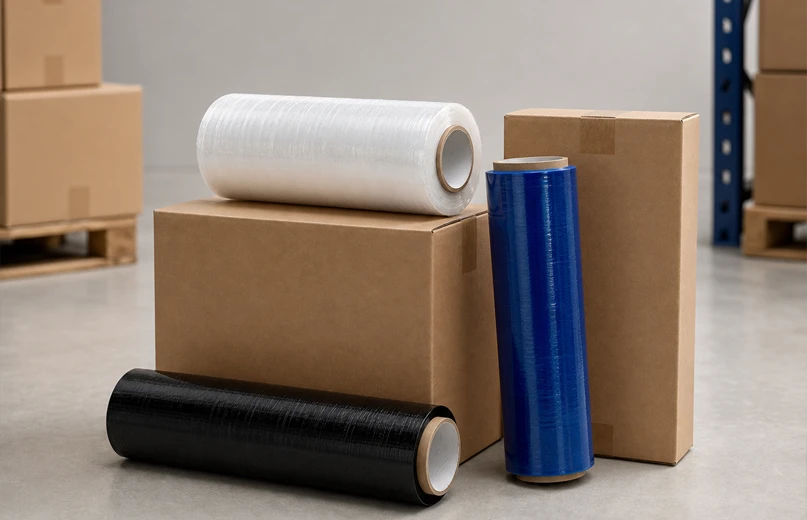
Hand Stretch Film vs. Machine Stretch Film: Which Is Right for Your Operation?
Quick answer: Hand stretch film is usually best for lower-volume operations, mixed pallet sizes, and wrapping in multiple locations. Machine stretch film is designed for compatible stretch-wrapping equipment and is generally better for repeatable, higher-volume pallet wrapping. The right choice depends on daily pallet count, load type, labor, equipment, film specifications, and required load containment.
What is hand stretch film?
Hand stretch film is applied manually around a pallet or bundled product. Common formats include standard hand rolls, extended-core rolls, and bundling film. It requires little equipment and can be practical for operations with a limited number of pallets, irregular loads, or wrapping stations spread across a facility.
Manual application is flexible, but results can vary between operators. Film tension, overlap, wrap pattern, and the number of revolutions all influence load containment and film consumption.
What is machine stretch film?
Machine stretch film is made for use with compatible stretch-wrapping equipment. A properly configured system can apply film with a more consistent pattern and controlled stretch. This can improve repeatability and throughput when an operation wraps many similar pallet loads.
Machine film is not interchangeable with every wrapper. Confirm roll width, core dimensions, film gauge or performance specification, pre-stretch capability, equipment settings, and load requirements before ordering.
Hand stretch film vs. machine stretch film
| Factor | Hand Stretch Film | Machine Stretch Film |
|---|---|---|
| Best fit | Lower or variable wrapping volume | Higher, repeatable wrapping volume |
| Application | Applied manually | Applied with compatible equipment |
| Initial equipment | Minimal | Stretch wrapper required |
| Consistency | Depends more on operator technique | Can be more repeatable when correctly configured |
| Mobility | Easy to use in different locations | Typically centered around a wrapping station |
| Good candidates | Mixed loads, occasional pallets, small facilities | Standardized loads, production lines, distribution operations |
How to choose the right stretch film
1. Count pallets and review workflow
Estimate pallets wrapped per shift and note where wrapping occurs. A machine may improve consistency at a fixed high-volume station, while hand film may remain practical for occasional or decentralized use.
2. Describe the load
Record pallet dimensions, weight, load height, product stability, sharp edges, corner conditions, and whether the load is uniform or irregular. A tall, unstable, or sharp-edged load may require a different film or additional protection.
3. Consider storage and transportation
ASTM D4649 addresses stretch film used to unitize, reinforce, and palletize loads for indoor storage and transportation environments. Extreme temperatures and outdoor exposure can affect performance, so those conditions should be discussed with the supplier.
4. Compare performance, not gauge alone
Gauge is one specification, but film formulation, stretch characteristics, puncture resistance, cling, equipment settings, wrap pattern, and containment requirements also matter. Two films with similar nominal thickness may perform differently on the same load.
5. Test the completed load
The practical question is whether the wrapped pallet stays contained through handling, storage, and transportation. Trial the film on representative loads and document the settings or manual wrap pattern that works.
Frequently asked questions
Can machine stretch film be applied by hand?
It is better to use film designed for the intended application. Machine rolls, cores, and performance characteristics are selected for equipment use and may be difficult or inefficient to apply manually.
Is thicker stretch film always stronger?
Not necessarily. Thickness is important, but formulation, stretch, puncture resistance, load shape, application method, and containment requirements must also be considered.
When does a stretch wrapper make sense?
It may make sense when pallet volume, labor requirements, film consistency, or production flow justify equipment. The decision should consider total operating needs rather than pallet count alone.
Discuss your pallet-wrapping application
Vertex Packaging Supplies offers hand stretch film, machine stretch film, bundling film, extended-core options, and related packaging supplies. Contact our team with your pallet dimensions, load weight, daily volume, application method, and handling conditions to discuss suitable options.
Technical reference: ASTM D4649-20(2025), Standard Guide for Use of Stretch Films and Wrapping Application.